Understanding Home Battery Backup Systems for Reliable Power
Homeowners face growing risks from power outages due to strained grids, severe weather, and rising demand. A well-chosen battery backup system maintains essential functions, from lighting to refrigeration, during these events. These systems serve as more than emergency tools; they integrate with daily energy use to lower costs and promote sustainability.
This guide details the mechanics of battery systems, their adaptation to various climates, critical specifications for durability, and practical steps for implementation. Readers gain insights to select systems that align with specific needs and local conditions.
Core Mechanics of Home Battery Systems
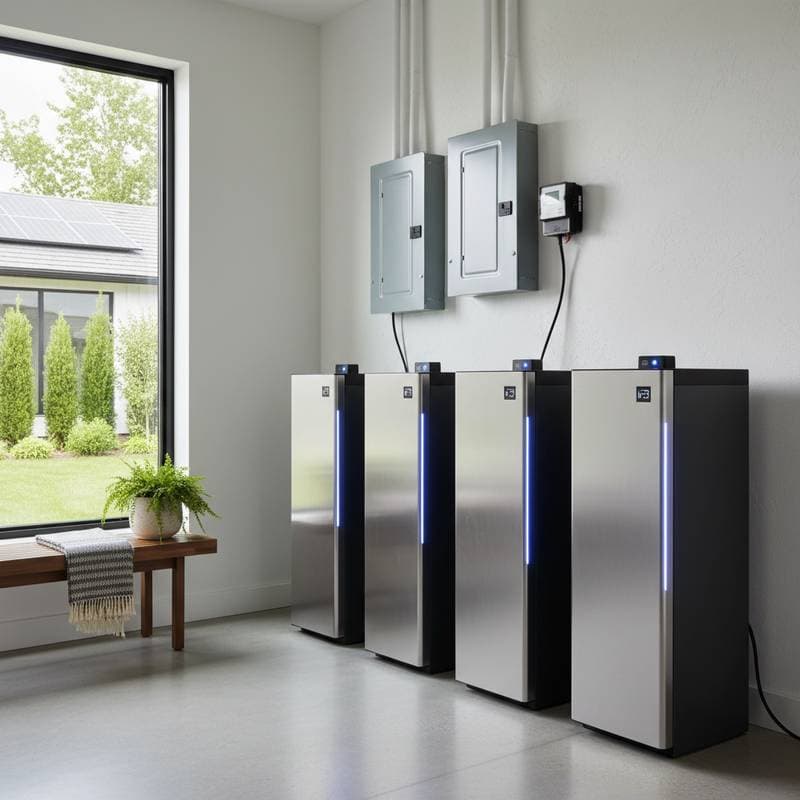
Home battery systems capture and store electrical energy for on-demand release. In standard operation, batteries charge from the utility grid, solar panels, or auxiliary generators. Upon detecting a grid failure, an inverter activates a transfer switch to disconnect the home and deliver stored power to designated circuits.
Key elements include battery modules that hold direct current energy, an inverter that converts it to alternating current for appliances, and a battery management system that oversees voltage, temperature, and cycle health. An automatic transfer switch ensures rapid response, often within milliseconds. Round-trip efficiency rates the energy recovery; for instance, a 95 percent efficient system yields 9.5 kilowatt-hours from a 10-kilowatt-hour charge, minimizing losses from conversion and heat.
Types of Battery Backup Systems
Battery systems vary by connection and purpose, each suited to different home setups.
Grid-Tied Systems
Grid-tied batteries link to the utility network and often complement solar installations. They capture surplus solar output or low-cost grid power for storage. In outages, they isolate and power the home independently.
- Efficiency: 93 to 96 percent round-trip
- Ideal for: Residences with solar panels or net metering
- Advantages: Superior energy recovery, seamless transitions, reduced utility bills
- Limitations: Dependence on grid isolation components; needs compatible hybrid inverters
Off-Grid Systems
Off-grid batteries function without utility ties, supporting total self-sufficiency. They pair with expansive solar setups and generators for continuous supply.
- Efficiency: 90 to 94 percent round-trip
- Ideal for: Isolated locations or areas with frequent blackouts
- Advantages: Full outage protection, expandable storage
- Limitations: Elevated initial expenses, demands careful energy monitoring
Hybrid Systems
Hybrid batteries blend grid access with standalone capabilities, enabling backup alongside daily optimization.
- Efficiency: 94 to 96 percent round-trip
- Ideal for: Properties balancing reliability and savings
- Advantages: Versatile operation, solar compatibility, peak-hour shifting
- Limitations: Intricate setup, potential need for custom inverter settings
Seamless Integration with Home Infrastructure
Effective battery systems align with existing electrical setups to ensure safety and performance. Inverters must match the main panel, while circuits divide into essential and secondary groups.
Priority loads typically encompass HVAC components, refrigeration units, interior lights, communication devices, and health-related equipment. For solar integration, select inverters supporting direct current or alternating current coupling. Examples include the Tesla Powerwall 2, offering 13.5 kilowatt-hours with 90 percent usable capacity, or the Enphase IQ Battery 10, achieving 96 percent efficiency with integrated safeguards.
Larger options like the LG ESS Home 8 or Generac PWRcell allow modular additions for increased demands. If the panel requires expansion or grounding updates, consult code standards such as NEC 706. A licensed electrician handles these adjustments to meet local regulations.
Step-by-Step Installation Process
Professional installation secures functionality and adherence to standards. Begin with a thorough load evaluation to quantify consumption and prioritize circuits.
Next, design the system by choosing capacity, inverter power, and layout. Secure necessary permits from electrical and building authorities. Proceed to physical setup, panel connections, and testing for swift transfer activation.
Finally, configure monitoring tools to observe usage, battery health, and outage responses. This process upholds warranties and prevents hazards.
Broader Impacts on Environment and Grid Stability
Home batteries extend benefits beyond individual protection by easing grid pressures. They balance peak loads and bolster renewable inputs, decreasing dependence on high-emission plants.
Key advantages involve cutting carbon outputs, maximizing clean energy use, and reducing distribution inefficiencies through on-site generation. Utility virtual power plant initiatives let owners contribute battery capacity during crises, earning credits for controlled discharges that stabilize the network.
Steps to Select and Implement Your System
Start by auditing energy patterns to pinpoint usage and vital loads. Assess regional weather to choose batteries resilient to heat, cold, or humidity, such as lithium-iron-phosphate types for wide temperature tolerance.
Investigate rebates from utilities or tax incentives that offset expenses. Engage installers certified in advanced configurations and code compliance. Opt for scalable designs that accommodate future expansions, like adding modules as needs evolve.
A strategic battery investment converts outage vulnerabilities into strengths. Homeowners achieve sustained power, financial efficiency, and network contributions, fostering a dependable energy future through informed choices and expert execution.