Key Takeaways
- Whole-home solar battery backup systems typically cost between $12,000 and $28,000, influenced by factors such as home size, required storage capacity, and selected equipment quality.
- Effective systems prioritize a balance between energy independence and practical storage requirements, rather than pursuing the largest possible capacity.
- Advances in battery technology favor lithium-iron phosphate options, which excel in durability, safety, and long-term performance.
- Storage needs generally range from 10 to 20 kWh for most households, sufficient to cover essential loads during outages while integrating with solar generation.
- Incentives like federal tax credits can reduce upfront costs by up to 30 percent, making installation more accessible.
- Modern systems enhance home value and provide reliable backup, with modular designs allowing for future expansions.
Calculating the Cost of a Solar Battery Backup System
The total cost of a solar battery backup system depends primarily on the energy storage capacity required for your household, expressed in kilowatt-hours (kWh). This capacity determines how long the system can power your home during an outage or at night when solar panels are not generating electricity. Additional factors include the type of battery chemistry, inverter compatibility, and local installation complexities.
For a standard three- to four-bedroom home with moderate energy use, expect costs to start at $12,000 for basic setups and climb to $28,000 for comprehensive systems that support extended off-grid operation. Prices reflect not only hardware but also professional integration to ensure seamless performance with existing solar arrays or grid connections.
Detailed Cost Breakdown
| Component | Average Cost Range | Description |
|---|---|---|
| Battery unit (10–15 kWh) | $7,000–$12,000 | Provides the primary energy storage; lithium-iron phosphate models offer superior cycle life and thermal stability. |
| Hybrid inverter | $2,000–$4,000 | Manages power conversion from DC to AC, optimizes solar input, and directs energy flow between battery, home, and grid. |
| Installation labor | $3,000–$5,000 | Involves electrical wiring, structural mounting, permitting, and system testing to meet local codes. |
| Monitoring software and accessories | $500–$1,000 | Includes apps for real-time energy tracking, remote diagnostics, and safety features like automatic shutoff. |
A mid-range configuration, such as a 13 kWh battery paired with a hybrid inverter, often totals around $18,000 before incentives. Larger homes or those in areas prone to severe weather may require robust setups exceeding $25,000 to handle high-demand appliances like air conditioning or electric vehicle charging.
Determining the Right Storage Capacity for Your Home
Most households require 10 to 20 kWh of storage to achieve meaningful backup during outages, based on average daily energy consumption and desired autonomy. This amount allows coverage of critical circuits—such as refrigerators, lights, medical devices, and communication equipment—for 12 to 24 hours, with solar recharging extending usability on subsequent days.
To calculate your needs precisely, review your utility bill for monthly kilowatt-hour usage and divide by 30 to find daily averages. For example, a home consuming 30 kWh per day might need at least 10 kWh of storage to bridge overnight gaps, assuming a 5–10 kW solar system generates during daylight. Factor in outage duration: brief events call for smaller capacities, while prolonged blackouts benefit from 20 kWh or more to sustain full-home loads.
Consider peak usage patterns, such as evening cooking or heating in winter, which increase demands. Oversizing slightly provides flexibility for future additions like electric appliances, but avoid excess to control costs—every additional kWh adds roughly $700 to $1,000.
Reasons Homeowners Invest in Battery Backup Today
Rising frequency of grid outages, driven by extreme weather and aging infrastructure, has prompted many to seek reliable alternatives to traditional power sources. Solar battery systems deliver energy independence by storing excess daytime generation for use when needed, reducing reliance on volatile utility rates that have increased by 15 to 20 percent in recent years across many regions.
Beyond reliability, these installations boost property appeal. Appraisers note that homes with integrated solar and storage command premiums of 3 to 4 percent, as buyers value resilience and lower long-term energy bills. Environmentally, batteries minimize fossil fuel dependence during backups, aligning with sustainability goals.
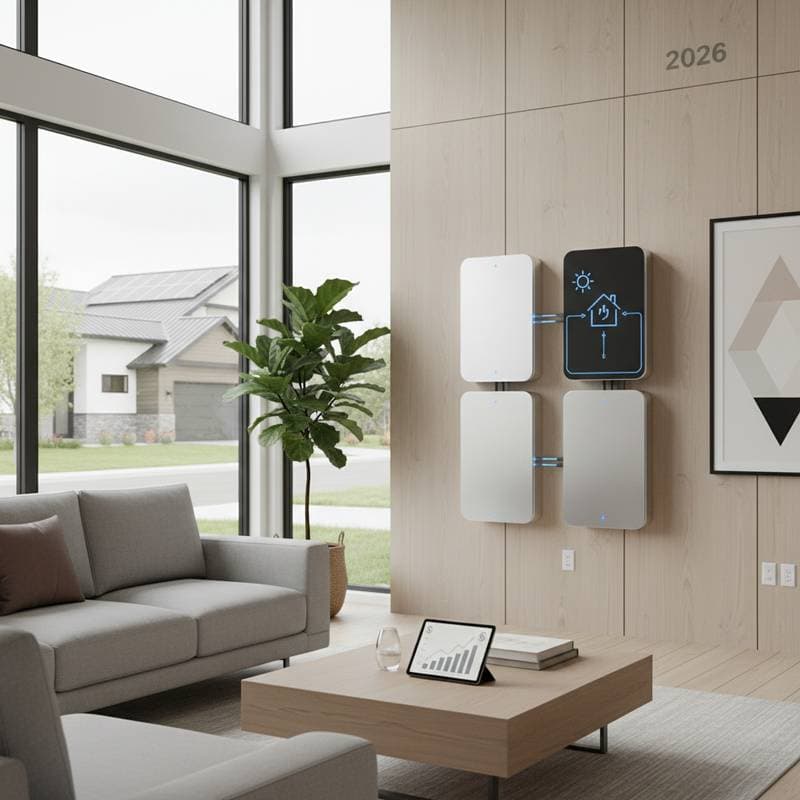
Aesthetically, contemporary units feature compact, weather-resistant enclosures that install discreetly in garages, basements, or exterior walls. Quiet operation and minimal visual impact make them suitable for urban and suburban settings alike.
Addressing Common Questions About Solar Battery Systems
Can a Solar Battery Power My Entire Home During an Outage?
A properly sized whole-home system with 20 kWh or greater capacity can sustain most household loads, including HVAC, kitchen appliances, and electronics, for several hours to days. Smaller 10 kWh units prioritize critical circuits via a subpanel, ensuring essentials remain operational while deferring non-vital uses.
What Is the Expected Lifespan of a Solar Battery?
Lithium-iron phosphate batteries typically retain at least 80 percent capacity after 10 to 15 years of daily cycling, equating to thousands of charge-discharge cycles. Factors like temperature control and partial-depth discharges influence longevity; professional monitoring detects issues early to maximize service life.
Should Batteries Be Installed Alongside Solar Panels?
Installing batteries concurrently with solar panels optimizes efficiency and reduces expenses, as shared labor and compatible components streamline the process. Retrofitting later incurs additional costs for inverter upgrades, but modular systems accommodate expansions without full replacements.
What Maintenance Do Solar Batteries Require?
These systems demand little upkeep: periodic visual inspections for dust or damage, ensured proper ventilation to prevent overheating, and software updates for optimal performance. Annual professional checks verify connections and battery health, often covered under warranties spanning 10 years.
Is It Possible to Expand Battery Capacity Over Time?
Modular designs in leading systems allow stacking additional units, enabling homeowners to begin with 10 kWh and scale to 30 kWh or more as needs evolve. This approach spreads costs and adapts to changes like family growth or increased electrification.
Daily Life with a Solar Battery System
Integration into routine feels seamless, with intuitive apps displaying energy flows—solar production, battery charge levels, and grid imports—in real time. Users gain control by setting priorities, such as reserving 50 percent capacity for emergencies or discharging during peak pricing to offset bills.
The system's unobtrusive presence enhances comfort: wall-mounted batteries occupy minimal space, often resembling sleek server racks, and operate silently without the hum of generators. During the inaugural outage, the assurance of uninterrupted power transforms potential disruption into a minor inconvenience, underscoring the investment's value.
Steps to Install Your Solar Battery Backup
Begin by auditing your energy profile through utility data and consulting a certified installer for a site assessment. Explore financing options, including the 30 percent federal Investment Tax Credit, which applies to both solar and storage components through 2032.
Select reputable brands like those using lithium-iron phosphate for proven reliability, and prioritize systems certified for safety standards. Finalize with a detailed quote outlining warranties, timelines, and performance guarantees to ensure a smooth transition to energy resilience.