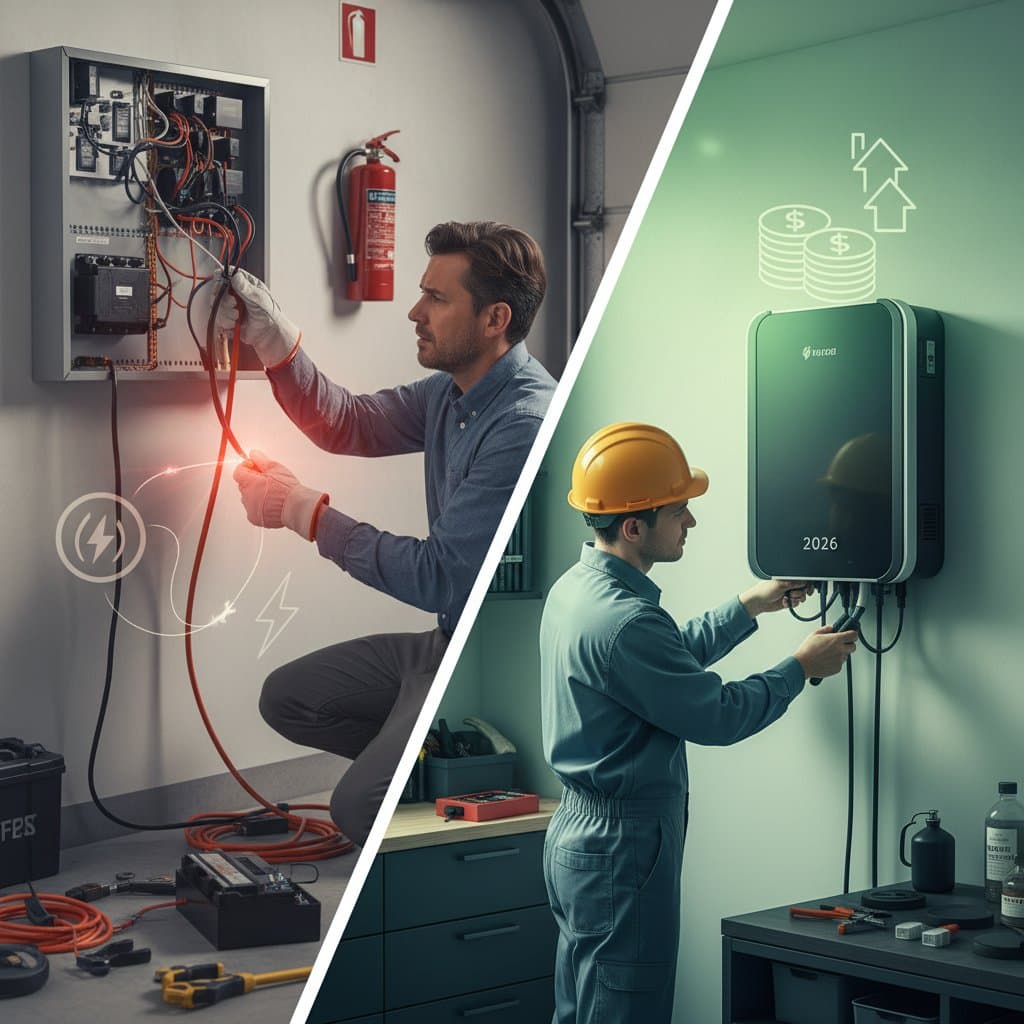
DIY Solar Battery Safety Risks Versus Professional Installation Savings
Homeowners often seek affordable ways to incorporate solar energy storage into their homes. Building a solar battery system independently appeals to those aiming to cut costs and achieve greater energy autonomy. However, the allure of immediate savings must be weighed against substantial safety concerns that can lead to hazardous outcomes.
This article examines the functions of a solar battery system, contrasts do-it-yourself approaches with expert installations, and provides practical guidance. Readers will gain insights to determine the most suitable path for their energy needs.
Key Components of a Solar Battery System
A functional solar battery system relies on several interconnected elements, each performing a critical role in energy capture, storage, and distribution.
-
Solar Panels: These devices absorb sunlight and convert it into direct current electricity. Selection depends on roof space, sunlight exposure, and household energy demands; for instance, a typical home might require 10 to 20 panels rated at 300 to 400 watts each.
-
Charge Controller: This component manages the voltage and current from the panels to the battery, avoiding overcharge that could damage cells. Pulse width modulation or maximum power point tracking controllers offer varying levels of efficiency, with the latter providing up to 30 percent more energy harvest in variable conditions.
-
Battery Bank: The core storage unit, often composed of lithium-ion cells for their high energy density and cycle life of 5,000 to 10,000 charges. Sizing the bank involves calculating daily energy use; a 10-kilowatt-hour capacity suits moderate households, expandable for higher demands.
-
Inverter: Essential for usability, it transforms direct current from the battery into alternating current compatible with standard appliances. Hybrid inverters, which integrate charging and grid-tie functions, simplify setups and enhance reliability during outages.
-
Safety Equipment: Fuses interrupt excessive current, disconnect switches isolate components for maintenance, and grounding rods prevent voltage buildup. Breakers rated for the system's amperage, typically 50 to 100 amps, add an extra layer of protection against faults.
Proper integration of these parts demands precise calculations and adherence to standards. Professionals excel in this area, ensuring compatibility and optimal performance from the outset.
Potential Safety Hazards in DIY Installations
Handling high-energy electrical systems without expertise introduces significant dangers. Solar batteries operate at voltages exceeding 48 volts in many configurations, amplifying the consequences of errors.
Key risks encompass:
-
Electrical Shock: Contact with live wires or terminals can deliver severe shocks, potentially causing burns, cardiac arrest, or falls from ladders during installation. Insulating tools and double-checking connections mitigate this, yet novices often overlook subtle voltage leaks.
-
Fire Ignition: Faulty wiring, such as undersized cables leading to resistance heating, or lithium-ion thermal runaway from overcharging, can spark fires. Incidents have risen with DIY projects, where improper fusing fails to contain arcs.
-
Toxic Chemical Release: Punctured or overheated batteries release electrolytes containing cobalt and lithium compounds, which irritate skin, eyes, and respiratory systems. In enclosed spaces, fumes pose inhalation risks, necessitating immediate ventilation and professional cleanup.
-
Equipment Malfunction: Incompatible components, like pairing a 12-volt battery with a 24-volt controller, cause inefficiencies or cascading failures. This not only erodes savings but can overload home circuits, tripping breakers or damaging appliances.
Certified installers adhere to National Electrical Code requirements, incorporating arc-fault circuit interrupters and surge protectors. Such measures reduce incident rates dramatically compared to unverified DIY efforts.
Strategies for Safe DIY Implementation
For those committed to a hands-on approach, beginning modestly builds skills while minimizing exposure to home-wide risks. Portable systems for off-grid uses, such as RVs or backup power, serve as ideal starting points with voltages under 24 volts.
Practical steps to enhance safety include:
-
Select Pre-Assembled Kits: Opt for UL-listed packages from reputable manufacturers, which bundle matched components and include pre-wired harnesses. These often feature integrated battery management systems that monitor temperature and voltage in real time.
-
Adhere Strictly to Guidelines: Review datasheets for voltage ratings and torque specifications on connections; for example, battery terminals require 5 to 7 foot-pounds of torque to ensure secure, vibration-resistant bonds.
-
Employ Personal Protective Equipment: Insulated gloves rated for 1,000 volts, safety goggles, and non-conductive footwear form the baseline. Face shields protect against arc flashes during testing.
-
Conduct Phased Testing: Power up the system incrementally, using a multimeter to verify continuity and insulation resistance above 1 megohm. Monitor for temperature rises exceeding 10 degrees Celsius, which signal potential issues.
-
Prioritize Air Circulation: Install batteries in cool, dry locations with at least 6 inches of clearance on all sides. Exhaust fans rated for corrosive environments help dissipate hydrogen gas from lead-acid alternatives, though lithium types produce less.
Success in these controlled scenarios fosters competence, potentially paving the way for supervised expansions.
Evaluating Costs and Enduring Benefits
Initial outlays for DIY systems range from $5,000 to $15,000 for a basic 5-kilowatt-hour setup, versus $10,000 to $25,000 for professional equivalents. However, hidden expenses erode DIY advantages: faulty installations may incur $1,000 to $5,000 in repairs, plus lost productivity during downtime.
Professionals offer warranties spanning 10 to 25 years, covering labor and parts, alongside performance guarantees of 80 percent capacity retention after a decade. Incentives like tax credits further amplify returns, often recouping investments in 5 to 7 years.
Long-term analysis reveals professional systems deliver 20 to 30 percent higher efficiency through optimized sizing and monitoring apps that track usage patterns. Factoring in insurance discounts for certified setups and avoided liability claims, the premium investment yields compounded savings.
Advancing Toward Reliable Energy Independence
Choosing between DIY and professional routes hinges on skill assessment, budget constraints, and risk tolerance. Small-scale trials equip enthusiasts with knowledge, while complex home integrations benefit from expert oversight.
Ultimately, a well-executed solar battery system enhances resilience against outages and trims utility dependence. Homeowners who prioritize safety and efficiency position themselves for sustainable gains, transforming energy management into a strategic asset.