Best Solar Shingle ROI: Tesla vs GAF in 2026
Homeowners seeking to integrate clean energy production with enhanced aesthetic appeal increasingly choose solar shingles. These innovative roof-integrated panels generate electricity while providing durable protection against weather elements. The leading options in this market are Tesla Solar Roof and GAF Timberline Solar. Both systems reduce energy bills and offer contemporary designs, yet their return on investment varies based on initial costs, performance efficiency, and installation considerations.
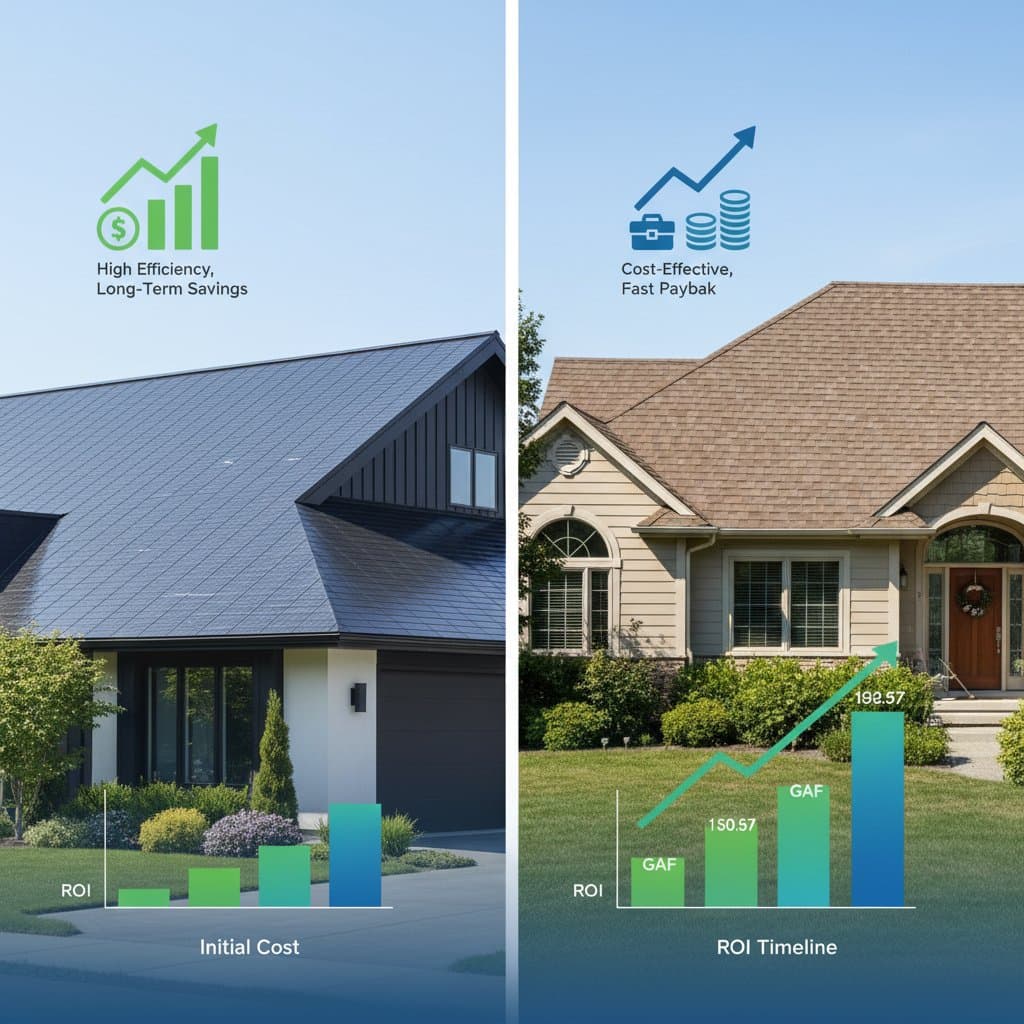
This analysis compares Tesla and GAF solar shingles to help determine which option yields the strongest ROI for specific home setups.
Understanding Solar Shingle ROI
Return on investment for solar shingles calculates the period required for energy savings and incentives to offset the initial expenditure. Primary factors shaping this timeline include installation expenses, energy output levels, prevailing electricity rates, available incentives, and existing roof conditions.
- Installation cost: Encompasses materials and labor, often ranging from $20,000 to $100,000 depending on system scale.
- Energy production: Measured in kilowatt-hours per year, influenced by shingle efficiency and sunlight exposure.
- Utility rates: Higher local costs accelerate savings per generated unit of power.
- Incentives: Federal tax credits, such as the 30% Investment Tax Credit, along with state rebates, lower effective costs.
- Roof condition: Full replacements add expenses, while partial integrations minimize them.
Typical payback periods span 8 to 14 years for most installations. Systems balancing affordability with robust output achieve shorter recovery times, often under 10 years in high-sunlight regions.
GAF Timberline Solar Overview
GAF Timberline Solar employs a hybrid strategy, embedding solar modules within a conventional asphalt shingle framework. This approach allows selective integration, avoiding the need for complete roof overhauls and suiting homes requiring targeted solar adoption.
Key advantages:
- Reduced upfront costs compared to full-system alternatives, typically $3 to $5 per watt installed.
- Quicker deployment by certified roofing professionals, often completed in one to two weeks.
- Seamless aesthetic integration with existing shingle styles for a uniform appearance.
Drawbacks:
- Efficiency ratings of 17% to 19%, marginally below premium competitors.
- Limited built-in smart features, requiring add-ons for advanced monitoring.
- Energy storage necessitates compatibility with external batteries like those from Enphase or Sonnen.
This system appeals to property owners undergoing roof repairs who desire solar benefits at a fraction of premium pricing.
Tesla Solar Roof Overview
Tesla Solar Roof replaces the entire roofing surface with a mix of active solar tiles and inactive steel tiles, creating a unified, high-performance barrier. Each tile functions dually as a weatherproof element and power generator, emphasizing durability and visual elegance.
Key advantages:
- Superior efficiency of 20% to 22%, maximizing output from limited roof space.
- Seamless integration with Tesla Powerwall for on-site storage and app-based control.
- 25-year warranty covering both energy production and weather resistance.
Drawbacks:
- Elevated costs, averaging $6 to $10 per watt due to custom fabrication.
- Restricted to Tesla-certified installers, potentially extending wait times.
- Installation durations of four to eight weeks, depending on roof complexity.
Tesla's offering targets forward-thinking homeowners prioritizing innovation and longevity over immediate affordability.
Factors That Influence ROI
Individual home characteristics significantly alter solar shingle performance and financial returns. Addressing these elements during planning optimizes outcomes.
-
Roof Orientation and Pitch: Optimal south-facing orientations at 30- to 40-degree pitches capture peak sunlight, boosting annual production by up to 20%. East- or west-facing setups reduce yields, extending payback by one to two years.
-
Local Electricity Rates: Regions with rates exceeding $0.20 per kilowatt-hour, such as California or New York, shorten ROI through amplified bill reductions. Lower-rate areas, like the Midwest, may extend timelines unless offset by incentives.
-
Roof Size and Complexity: Expansive or multi-pitched roofs elevate labor demands, particularly for Tesla's bespoke tiles. GAF's adaptable modules accommodate irregular shapes more economically, saving 10% to 15% on complex jobs.
-
Incentives and Rebates: The federal solar tax credit slashes costs by 30%, while programs like California's SGIP offer battery rebates up to $5,000. Local utilities may provide additional net metering benefits.
-
Household Energy Usage: High-consumption homes, including those with EVs or pool pumps, offset more grid reliance. A typical 5-kilowatt system saves $1,000 to $2,000 annually in sunny climates.
Pros and Cons Summary
Tesla Solar Roof
Pros:
- Aesthetic excellence with customizable tile colors and textures.
- Advanced efficiency and ecosystem compatibility for whole-home automation.
- Extended durability, resisting hail up to 1.75 inches and winds over 110 mph.
Cons:
- Substantial initial investment, often $50,000 to $100,000 for average homes.
- Availability constrained by installer capacity and supply chains.
- Demands full roof replacement, unsuitable for minor upgrades.
GAF Timberline Solar
Pros:
- Cost efficiency at $20,000 to $50,000 for comparable output.
- Broad installer network for prompt scheduling.
- Versatile application on new or existing roofs without total disruption.
Cons:
- Modest efficiency limits scalability for energy-intensive properties.
- Basic monitoring requires third-party apps or devices.
- Less premium finish may not elevate home resale value as dramatically.
Strategies to Enhance ROI
Maximizing returns involves strategic planning and ongoing management.
- Pair shingles with battery storage to store excess daytime production for evening use, potentially increasing savings by 25%.
- Time installations for late fall or early spring to secure off-season discounts of 5% to 10%.
- Pursue all eligible incentives, including property tax exemptions in solar-friendly states.
- Conduct annual inspections and debris removal to maintain 95% efficiency over the system's life.
- Utilize manufacturer apps to track output and identify underperformance early, avoiding costly repairs.
These practices extend system lifespan and amplify financial benefits.
Selecting the Optimal System
Tesla Solar Roof excels for homeowners committed to long-term residency and a futuristic aesthetic. Its integrated design enhances property value by up to 5% in eco-conscious markets, ideal for those valuing technology over cost.
GAF Timberline Solar provides superior value for budget-focused upgrades, particularly during routine roof replacements. It achieves payback in 8 to 10 years for many users, balancing reliability with accessibility.
Evaluate both against your energy goals, budget, and roof specifications for the best fit.
Next Steps for Implementation
Consult certified installers from Tesla or GAF for a site assessment. They will model projected energy yields, detail financing options, and compute a tailored ROI based on your location and usage patterns. This professional input ensures a decision aligned with your home's potential and financial objectives.