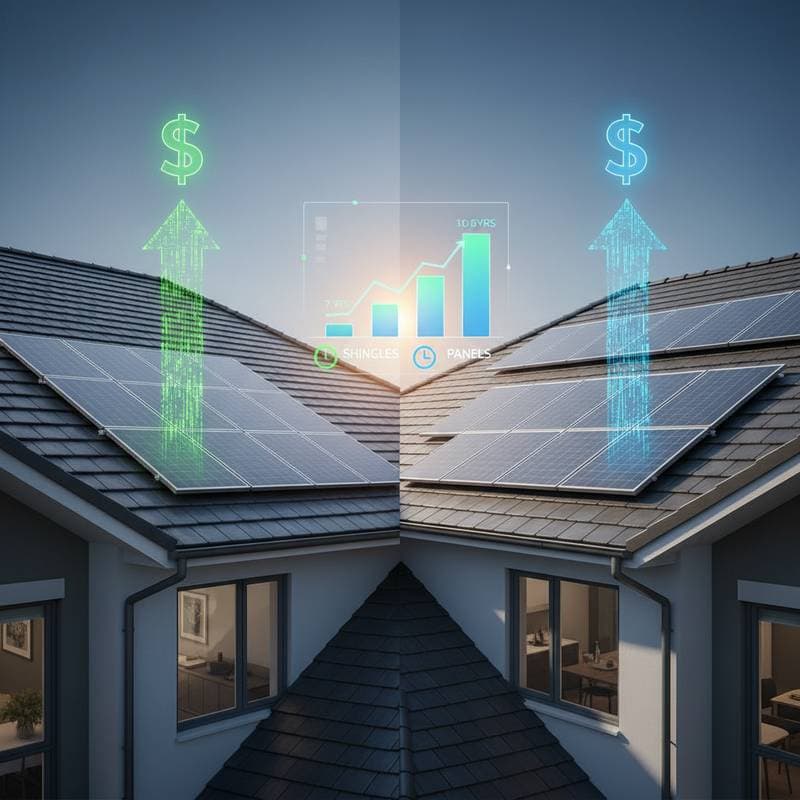
Solar Shingles vs Panels: Which Delivers Faster Payback in 2026
Homeowners increasingly view their roofs as opportunities for energy independence. Traditional solar panels and innovative solar shingles both harness sunlight to generate electricity, yet they present distinct paths to savings and sustainability. This analysis examines costs, performance, and return on investment projections for 2026 to guide your decision toward the option that aligns with your home and budget.
Overview of Solar Panel Systems
Solar panels consist of rigid modules installed atop existing roofing. These systems employ photovoltaic cells to transform sunlight into usable power. Installation occurs without altering the underlying roof structure, making panels suitable for a wide range of homes.
Costs typically range from $2.50 to $3.75 per watt, encompassing materials and professional installation. A standard 6-kilowatt system thus requires an investment of $15,000 to $22,500 prior to incentives. Panels excel in scalability, allowing additions as energy needs evolve.
Overview of Solar Shingle Systems
Solar shingles integrate photovoltaic technology directly into roofing materials, functioning as both protective covering and energy producer. Each shingle embeds small solar cells, mimicking the appearance of conventional asphalt tiles for a streamlined roof design.
Pricing falls between $4 and $7 per watt, translating to $24,000 to $42,000 for a 6-kilowatt setup. This figure accounts for dual-purpose functionality, potentially offsetting expenses associated with roof replacement. Shingles appeal to those seeking architectural harmony without protruding hardware.
Factors Influencing Total Costs
Multiple elements shape the financial commitment for either system. A thorough evaluation of these components ensures realistic budgeting and maximizes value.
Roof Compatibility and Condition
Systems demand a structurally sound roof. Panels mount on current surfaces, but an impending reroof may necessitate separate labor, inflating expenses. Solar shingles replace worn materials entirely, potentially reducing overall outlay by $5,000 to $10,000 through consolidated work.
Variations in Installation Labor
Geographic location affects labor pricing significantly. Urban coastal areas command $1.25 to $1.75 per watt, whereas rural or inland regions average under $1.00 per watt. Such disparities can shift total costs by $3,000 to $5,000, underscoring the value of local quoting.
Available Incentives and Credits
Government programs diminish initial expenditures by 25 to 35 percent. Federal tax credits apply equally to both technologies, supplemented by state-specific rebates or per-kilowatt-hour payments. Verify eligibility, as interconnection protocols might vary by utility provider.
System Efficiency and Site-Specific Design
Optimal energy capture hinges on roof pitch and direction. South-facing orientations at 30 to 45 degrees yield peak output. Panels permit adjustable mounting for enhanced exposure, often surpassing fixed shingles in suboptimal setups and accelerating payback.
Analyzing Return on Investment
Payback timelines emerge from energy production offset against electricity rates, averaging $0.15 per kilowatt-hour saved. A 6-kilowatt panel array might produce 9,000 kilowatt-hours yearly, yielding $1,350 in annual reductions. Shingles, generating around 8,000 kilowatt-hours, deliver $1,200 in comparable savings.
Projected ROI for Solar Panels
Consider a $20,000 installation reduced to $14,000 post-incentives. With $1,350 yearly savings, payback occurs in 10 years. Over 20 years, net gains reach approximately $13,000, bolstered by rising utility rates and property value uplift.
Projected ROI for Solar Shingles
A $35,000 system nets to $25,000 after credits, recouping costs in 13 years at $1,200 annual savings. Twenty-year returns approximate $9,000. Aesthetic and integrative benefits may enhance home resale, offsetting longer timelines for design-focused owners.
Panels generally achieve quicker financial recovery, though shingles prove advantageous when roof renewal coincides with solar adoption.
Strategies to Optimize Expenses
Strategic planning minimizes outlays while preserving performance. Implement these approaches to refine your investment.
- Schedule installations during off-peak seasons like spring or fall, securing discounted rates amid favorable weather.
- Coordinate roofing and solar projects if replacement looms, trimming labor by 10 to 15 percent.
- Solicit quotes from at least three NABCEP-certified installers, where bids may differ by 20 percent.
- Explore zero-down solar loans with rates under 4 percent, aligning payments with energy bill reductions.
- Employ monitoring software to track production, averting inefficiencies that erode hundreds in yearly savings.
Obtain personalized assessments from regional experts to tailor these estimates to your property.
Scenarios Favoring Solar Shingles
Opt for shingles under these conditions:
- Imminent roof replacement demands new materials.
- Community guidelines prohibit prominent panel arrays.
- Seamless integration enhances architectural style.
- Long-term property enhancement outweighs upfront premiums.
Though payback extends, shingles elevate curb appeal and attract sustainability-minded purchasers, amplifying intangible returns.
Navigating Permits and Compliance
All installations adhere to municipal building codes and utility standards. Secure permits for structural integrity and electrical connections, typically processed in one to two weeks at $500 to $1,000.
Engage licensed professionals for all wiring to mitigate risks like fires or warranty invalidation. Reputable firms manage documentation, ensuring seamless integration with home systems.
Ensuring Long-Term Performance
Routine upkeep sustains efficiency and durability. Conduct biennial professional reviews of inverters, connections, and seals.
For panels, rinse surfaces quarterly using purified water and non-abrasive tools to clear obstructions. Shingle maintenance involves post-storm checks for damage or accumulation.
Allocate $200 to $400 yearly for these tasks, safeguarding output and warrantying 25-year lifespans.
Steps to Launch Your Solar Upgrade
Begin by auditing your roof and energy usage to pinpoint ideal capacity. Consult certified providers for site evaluations, prioritizing those with proven track records in your area. Factor in 2026 projections for incentives and technology advances to secure enduring benefits. This deliberate approach transforms your roof into a reliable asset, delivering sustained savings and environmental impact.