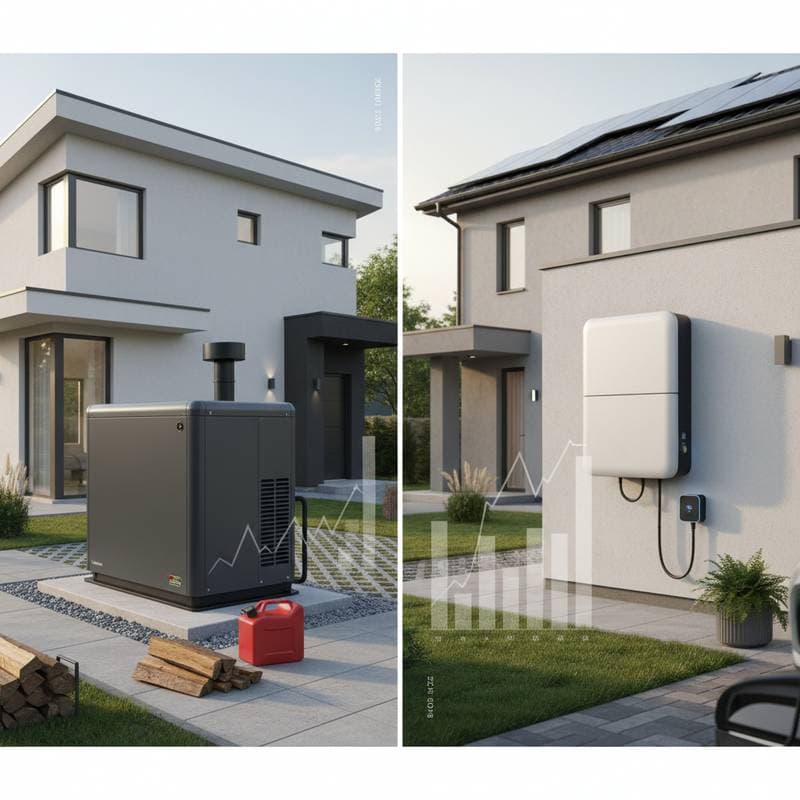
Generators vs. Battery Backups: Projected Costs for 2026
Power failures create inconvenience and potential hazards, particularly when essential services like heating, refrigeration, and connectivity rely on electricity. Homeowners increasingly seek reliable backup solutions amid rising outage frequencies due to weather events and grid vulnerabilities. Two primary choices emerge: fuel-powered generators and electricity-storing battery systems. Each option presents distinct financial implications, operational demands, and performance characteristics. A thorough examination of these elements empowers informed decisions aligned with household requirements and financial constraints.
Core Principles of Backup Power Systems
Generators and battery backups both sustain electricity flow during grid disruptions, yet their mechanisms differ fundamentally. Generators convert fuel sources, including gasoline, propane, or natural gas, into electrical energy through combustion engines. Battery backups, conversely, accumulate energy from the primary grid or renewable sources like solar panels and discharge it seamlessly upon outage detection.
Selection hinges on several factors: anticipated power consumption, desired outage duration, tolerance for routine upkeep, and preference for initial investment versus sustained expenditures. Homeowners in regions prone to brief interruptions may prioritize seamless automation, while those facing prolonged blackouts require extended runtime capabilities.
Detailed Cost Breakdown and Upkeep Considerations
Generators: Initial Affordability with Ongoing Commitments
Portable generators offer an accessible entry point, with basic units capable of supporting critical appliances starting at approximately $300 to $800 in 2026 projections, accounting for modest inflation. These models suffice for powering a refrigerator, sump pump, or select outlets during short disruptions. Standby generators, designed for automatic activation and whole-home coverage, range from $5,000 to $15,000, inclusive of basic installation fees that may reach $2,000 to $4,000 depending on electrical panel complexity and location.
Operational costs accumulate through fuel procurement and storage. Expect annual fuel expenses of $200 to $500 for occasional use, based on fluctuating prices for gasoline at around $4 per gallon or propane at $3 per gallon. Safe storage demands dedicated, ventilated containers compliant with local fire codes, adding $50 to $100 initially. Maintenance schedules include oil changes every 50 to 100 hours of operation, air filter replacements biannually, and spark plug inspections yearly, totaling $150 to $300 annually for professional servicing.
Advantages:
- Economical upfront purchase for portable variants
- Indefinite operation with sufficient fuel supply
- Versatile for extended outages exceeding 24 hours
Disadvantages:
- Necessitates secure fuel reserves and regular refueling
- Generates significant noise levels, often 60 to 80 decibels
- Emits carbon monoxide and other pollutants, requiring outdoor placement and ventilation
Battery Backups: Premium Entry with Minimal Recurrence
Battery systems command higher initial investments, with single-unit home batteries like those from leading manufacturers projected at $8,000 to $12,000 for 10 to 13 kilowatt-hour capacities in 2026. Multi-unit configurations for comprehensive home support escalate to $20,000 or more. Installation by certified electricians typically adds $1,500 to $3,000, involving transfer switch integration and panel modifications to enable automatic failover within seconds.
Ongoing costs remain low, primarily limited to occasional firmware updates and rare component checks, estimated at $100 to $200 per year. Recharging occurs passively from the grid during normal operation or actively via solar arrays, eliminating fuel dependencies. Lifespans extend 10 to 15 years with proper care, though capacity degrades by 20 to 30 percent over time, potentially necessitating partial replacements at $2,000 to $4,000 midway through service.
Advantages:
- Silent functionality below 50 decibels, ideal for residential settings
- Emission-free operation, enhancing indoor air quality
- Seamless compatibility with photovoltaic installations for energy independence
Disadvantages:
- Substantial upfront capital outlay
- Finite runtime, typically 4 to 12 hours for essential loads without supplemental recharging
- Mandatory professional setup to ensure code compliance and safety
Assessing Energy Demands and Appropriate Scaling
Determine backup requirements by calculating your home's load profile. Essential circuits, such as those for lighting, refrigeration, and medical devices, consume 5 to 10 kilowatts; prioritize these for cost-effective sizing. Whole-home needs may exceed 20 kilowatts, demanding robust systems. Tools like online wattage calculators assist in precise estimation: add the running watts of devices (e.g., 700 for a refrigerator, 1,200 for a furnace fan) and account for startup surges up to three times higher.
Regional outage patterns influence suitability. Areas with frequent micro-outages under two hours benefit from batteries' rapid response and recharge efficiency. In contrast, hurricane-prone zones with multi-day blackouts favor generators' fuel-extended endurance. Hybrid approaches, combining batteries for immediate bridging with generators for prolongation, emerge as viable for comprehensive resilience, though they increase complexity and cost by 20 to 30 percent.
Practical Strategies for Cost Management
For budget-conscious households, initiate with scalable options. Portable generators under $500 handle targeted essentials, expandable via paralleling kits for added capacity. Compact battery power stations, priced at $1,000 to $2,000, deliver 1 to 2 kilowatt-hours for devices like laptops and chargers, serving as foundational units for future solar integration.
Enhance system efficiency through proactive measures. Upgrade to LED lighting and Energy Star-rated appliances to reduce baseline draw by 20 to 40 percent. Install smart power strips that eliminate phantom loads from idle electronics. During outages, sequence device activation to avoid overloads: start with high-priority items like freezers, then layer in secondary needs.
Professional Integration for Safety and Compliance
Any interconnection to the home electrical system demands expert intervention to prevent hazards like backfeeding, which endangers utility workers and voids warranties. Licensed electricians verify grounding, install interlock kits or automatic transfer switches, and conduct load testing. Budget $500 to $1,500 for inspections and permits, ensuring adherence to National Electrical Code standards. DIY approaches suit only isolated portable use, never grid-tied setups.
Aligning Your Selection with Household Priorities
The optimal choice reflects lifestyle, environmental values, and risk tolerance. Generators excel for rural or storm-vulnerable homes seeking marathon reliability at moderated expense. Battery backups suit urban or eco-focused setups valuing convenience and green integration.
Conduct a personalized audit: list must-have appliances, review past outage durations, and project five-year costs using spreadsheets. Consult local incentives, such as tax credits for batteries under renewable programs, to offset investments. This deliberate process secures a tailored solution that safeguards comfort and continuity amid uncertainties.