Prepare Your HVAC for Spring: Filter Swap Saves $800
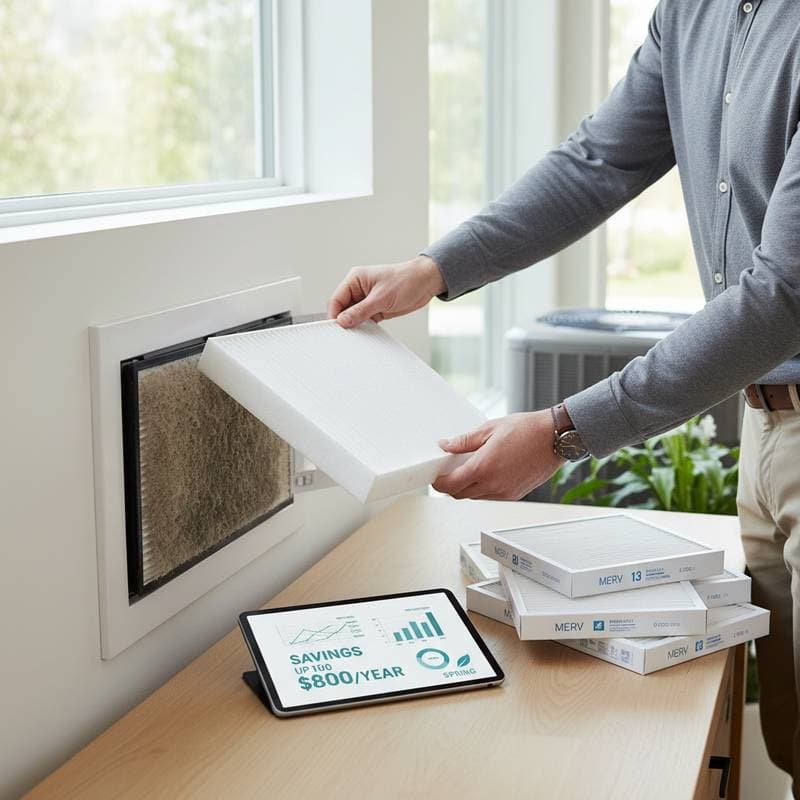
Overlooking the right maintenance routine for your HVAC system leads to hidden energy expenses that add up to hundreds of dollars annually. As warmer weather arrives and your system transitions from heating to cooling, proper airflow and filtration play key roles in maintaining efficiency. A straightforward step, such as replacing or upgrading your HVAC filter ahead of spring, can reduce yearly operating and repair costs by as much as $800. This savings stems from minimized airflow resistance, lower static pressure, and reduced buildup of particulates that strain system components.
Why Filter Maintenance Drives Efficiency
Your HVAC system operates like a precise air circulation loop. The blower motor draws air from return ducts, pushes it through the filter and coils, and then delivers it via supply ducts throughout your home. A clogged filter slows air velocity and elevates static pressure. As a result, the blower labors more intensely to sustain the intended airflow, which increases electricity usage and disrupts even temperature distribution in rooms.
Residential HVAC units typically handle a specific pressure drop, often about 0.5 inches of water column. An ignored filter can double this resistance, placing the motor under excessive load. In variable-speed models, the motor operates at elevated RPMs over extended periods. Fixed-speed systems experience diminished cooling output and potential coil freezing. These issues accelerate wear on parts and drive up utility bills significantly.
Understanding Different HVAC System Types
Each HVAC configuration responds uniquely to filter conditions. Recognizing your system's design helps tailor maintenance for optimal performance and savings.
Standard Split Systems
Standard split systems pair a furnace or air handler indoors with an outdoor condenser unit. Filters usually sit in the return plenum or wall-mounted grilles. Basic filters fall in the MERV 6 to 8 range. Advancing to MERV 11 or 13 enhances air quality, provided it aligns with your blower's capabilities. Excessive restriction from a higher-rated filter can impede airflow and cause problems.
- Efficiency Rating: 14 to 18 SEER
- Ideal Climates: Mild to moderate temperatures
- Key Maintenance: Replace filters every 60 days in areas with high pollen counts
For example, in a typical 2,000-square-foot home, a clean MERV 8 filter maintains steady airflow, keeping cooling costs 10 to 15 percent lower than with a dirty one.
Heat Pump Systems
Heat pumps switch refrigerant direction to handle both heating and cooling duties. Their year-round operation amplifies the consequences of airflow limitations. A top-tier heat pump rated at 20 SEER might forfeit 10 to 15 percent of its efficiency if filters go unchecked, leading to higher bills during peak seasons.
- Efficiency Rating: 16 to 22 SEER, 8.5 to 10 HSPF
- Ideal Climates: Moderate areas with few sub-freezing days
- Key Maintenance: Examine filters monthly during transitional seasons as the system changes modes
Homeowners in variable climates often notice quicker savings here, as consistent filtration supports balanced heating and cooling cycles.
Variable Refrigerant Flow (VRF) Systems
VRF setups connect multiple indoor units to one outdoor unit through precise refrigerant management. With filters often dedicated to each zone, uniform upkeep proves essential. Imbalanced airflow across areas can throw off refrigerant distribution, resulting in uneven efficiency and comfort.
- Efficiency Rating: 18 to 26 SEER equivalent
- Ideal Applications: Spacious residences or multi-zone setups
- Key Maintenance: Swap all filters at the same time to preserve even airflow
In larger properties, synchronized filter changes prevent one zone from overworking the system, potentially saving 20 percent on energy in zoned environments.
Key Factors in Filter Integration
Filter changes influence the entire HVAC network, from ducts to controls. Variations in static pressure can loosen duct seals, misalign dampers, and skew thermostat accuracy. Advanced thermostats that adjust fan speeds depend on predictable airflow patterns. Restricted filters lead to flawed sensor data and suboptimal comfort settings.
Before selecting an upgrade, review your blower's specs. Electronically commutated motors (ECM) adapt to slight resistance shifts, offering flexibility. Permanent split capacitor (PSC) motors lack this adaptability. Pairing a high-MERV filter with a PSC blower risks dropping airflow below safe thresholds. Opt instead for a media cabinet with extended pleats, which delivers superior filtration without excessive drag.
Consider real-world scenarios: A family upgrading to MERV 13 in a standard split system might see allergy relief alongside a 5 to 10 percent drop in monthly bills, but only if the blower handles the added resistance.
Practical Installation and Inspection Guidance
As you gear up for spring, assess these airflow essentials to ensure peak operation:
- Secure Filter Fit: Confirm the frame seals tightly, preventing air leaks that bypass filtration.
- Examine Return Ducts: Look for detached joints or worn insulation around filter access points.
- Inspect Blower Wheel: Clear dust from fan blades, as buildup hampers performance despite a fresh filter.
- Check Coil Condition: Scan evaporator fins for debris accumulation that imitates filter obstruction.
- Test Thermostat Settings: Ensure fan operates correctly in continuous or automatic modes.
Engage a certified technician for precise measurements of total external static pressure and airflow volume. Exceeding factory guidelines signals the need for duct adjustments or enhanced filter housings. Such diagnostics often uncover issues that yield immediate efficiency gains.
Sustaining Long-Term System Health
Regular filter care extends beyond cost reduction to bolster overall dependability. Fresh filters stabilize refrigerant levels, avert coil freeze-ups, and ease compressor workload. They also elevate indoor air quality by trapping winter-gathered allergens and particles, fostering a healthier living space.
Over time, this practice minimizes emergency repairs. For instance, consistent maintenance in heat pump systems can add years to compressor life, avoiding replacements that cost thousands.
Steps to Optimize Your HVAC Now
Take these targeted actions to implement changes and track results:
- Assess Current Filter Specs: Note dimensions, MERV rating, and airflow arrow orientation prior to buying replacements.
- Book a Professional Spring Service: Include static pressure checks and thorough coil cleaning in the visit.
- Log Replacement Dates: Mark installation on filters or a calendar to enforce steady intervals.
- Monitor Utility Trends: Review bills across seasons to quantify maintenance-driven reductions.
- Explore Enhancement Options: Weigh adding variable-speed blowers or digital filter sensors for ongoing performance insights.
By prioritizing these steps, you secure not only financial benefits but also reliable comfort year-round.