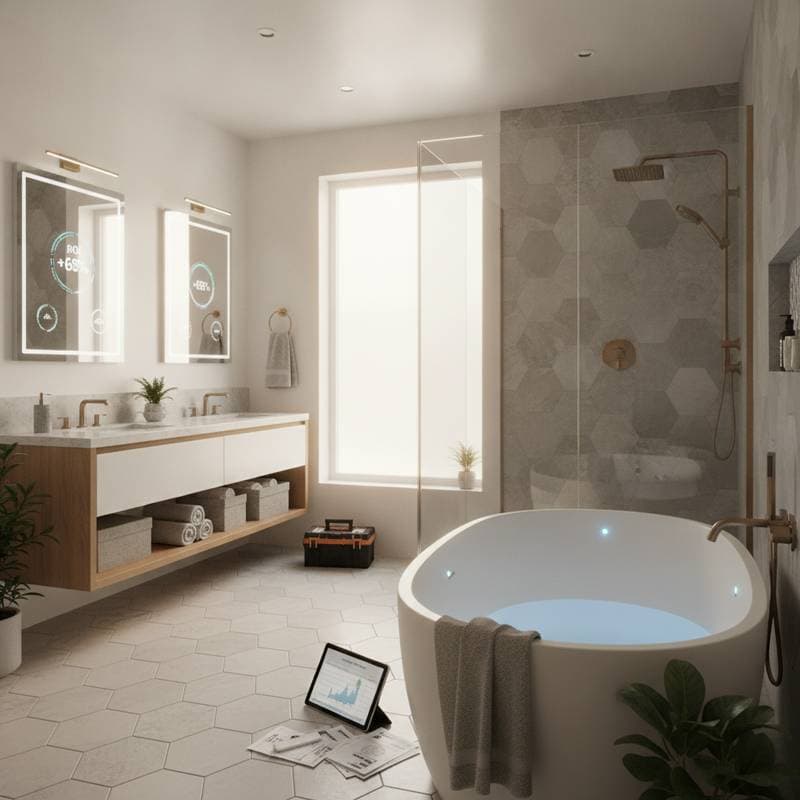
2026 Bathroom Remodel Costs: Key Shifts Revealed
The bathroom represents a compact space in any home, yet it prompts substantial renovation investments. Material price escalations, shifting design preferences, and updated water-efficiency regulations alter budgeting needs for 2026 projects. Early awareness of these dynamics enables precise planning and prevents financial setbacks during execution.
What Drives Bathroom Remodel Budget Changes
Homeowners allocate greater funds toward resilient finishes and fixtures that conserve energy. Analysts project material expenses to increase 8 to 12 percent over previous forecasts, stemming from supply chain realignments and elevated labor charges. Thoughtful preparation allows cost management while enhancing investment returns. Mid-range renovations recover 55 to 65 percent of expenses upon home sale.
Across the nation, modest bathroom refreshes begin at approximately $9,800. Luxury primary bathroom transformations surpass $40,000 in urban zones with premium labor rates. Notable surges occur in tile installations, plumbing components, and moisture-resistant barriers.
Essential Cost Factors to Consider
Multiple elements influence the overall expense of a bathroom project. Early evaluation of these components supports accurate financial projections.
- Fixture Specifications: Basic vanities commence at $400, whereas bespoke designs surpass $2,500.
- Tile Choices: Installed ceramic tiles range from $3 to $6 per square foot; porcelain or natural stone selections extend to $8 to $20 per square foot.
- Plumbing Modifications: Relocating elements incurs $2,000 to $4,000, varying by pipe routing and structural constraints.
- Permitting and Compliance: Fees total $300 to $900, with rigorous requirements in flood-risk or seismic regions.
- Labor Rates: Experienced professionals charge $75 to $125 hourly, affected by market demand and regional economies.
During bid evaluations, verify inclusion of waterproofing measures, debris removal, and exhaust system enhancements. These critical items frequently emerge as unforeseen charges.
Effective Strategies to Reduce Expenses
Timing and selection decisions lower outlays while preserving standards.
- Retain Existing Elements: Restore a current tub for $300 to $700, rather than install a new one at $2,000 to $4,000.
- Time Projects Strategically: Initiate work in late winter, when contractor availability rises and labor bids drop 5 to 10 percent.
- Source Discounted Inventory: Acquire surplus tile from vendors offering up to 40 percent reductions on phased-out patterns.
- Consolidate Scope: Integrate several bathroom improvements under one agreement to minimize setup costs and redundant efforts.
- Select Balanced Options: Intermediate-grade faucets and illuminations provide high-end functionality at reduced prices, often half of luxury equivalents.
Obtain three detailed proposals from regional specialists to assess material surcharges, project schedules, and protection guarantees.
Maximizing Return on Investment and Durability
Bathroom updates extend beyond visual appeal to improve efficiency, usability, and market worth. Upgrading obsolete components cuts water consumption by 30 percent, yielding annual savings of $100 to $200 on utilities.
A standard renovation elevates property value by $10,000 to $15,000. High-end enhancements position upscale residences for superior sale prices. Prospective buyers favor contemporary layouts featuring durable materials and effortless upkeep.
Energy-efficient showers and toilets not only comply with 2026 codes but also qualify for rebates in many locales, further offsetting initial costs. Integrating smart sensors for lighting and humidity control adds modern convenience without excessive expenditure.
Steps to Execute Your Renovation Plan
Identify core requirements separate from optional features. Compile visual references for preferred aesthetics and outline practical objectives, including expanded storage or enhanced illumination. Solicit comprehensive bids that detail components, workforce allocation, and completion dates.
Upon plan approval, procure supplies in advance to sidestep interruptions and stabilize pricing. Reserve 10 percent of the budget as a buffer for discoveries such as concealed leaks or obsolete electrical systems.
A 2026 bathroom renovation demands meticulous financial oversight and knowledgeable choices. The result delivers enduring satisfaction and amplified asset worth. Through grounded projections, qualified teams, and optimal scheduling, homeowners secure an elegant, efficient space that endures for years.